Suicide is painless

Death is inevitable, it is never easy for those left behind but we all have to accept that it will happen.

Of the too many people I have lost in my life time, I have personally known six men, one boy and one woman who have taken their own lives. I have also known two men and one woman who have lost their lives to knife crime. That is 11 people between 15 and 40 years old in.  

The effects of all these deaths are devastating to the family, friends and the wider community. Too many parents are burying their children. Too many young people are dealing with grief and fear.

We continue to suffer, often in isolation. We may act differently, driven by a need to prevent anyone going through what we are going through; or perhaps a guilt that we did not do enough; anger about the injustice of it all; fear that we may come to the same end; overwhelming sadness and loss.

As a society, we still do not seem to be able to come up with effective solutions and prevent further loss.

Political leaders and media campaigns express horror and concern temporarily tokenistic legislation, such as the appointment of a Minister for Suicide or increasing Stop and Search laws, but no real long term investment to address of these issues is made.

Racist and irresponsible reporting creates the illusion that knife crime is only a problem within a small section of society so it can be pigeonholed and overlooked and we can close our eyes again until someone in our neighbourhood is affected.

Stories of suicide of celebrities as young as Mike Thalassitis and as successful and established as Keith Flint and Robin Williams spark strong reactions for a short while. Even the stories as tragic as when young people suffering bullying or the high levels of suicides caused by unjust benefits decisions may raise concerns and shock us fleetingly but we are no longer surprised.

Mental Health and Wellbeing is an issue that is  currently in the headlines. However, the link between mental health and gang crime has been recognised for years. Young people with low self-esteem are more likely to be drawn into gangs and or Child Sexual Exploitation. Domestic Abuse in the home  creates a normalisation of the manipulative, controlling and violent behaviour that is also prevalent in criminal gang relationships. It also causes mental health issues such as PTSD, depression and anxiety and can lead to self-harming and risk taking behaviours.

For both causes of death,  we still have inadequate long-term preventative responses. Our public services are underfunded and ‘firefighting’, care thresholds have been raised so early intervention is less likely. Voluntary Sector services are picking up the pieces on the frontline whilst finding it harder than ever to get the financial support they need.

Nevertheless, they are unable to address the underlying reasons why people see no alternative in that critical moment or end up being victim and/or members of gangs.

In fact we have even created ways through social media to add to the anxieties of failure and amplified or glorify unattainable life-goals or magnify negative stories about young people. Our communication is through memes and Twitter, YouTube or Snapchat. Our words are reduced to texting. A recent study showed that ‘Instagram and Snapchat …[were] the most detrimental to young people’s mental health and wellbeing’.

We have a government that has created a ‘hostile environment’ for anyone in need of support. They are dismantling our NHS. Mental health services have at least 6 months waiting list. They have cut Local Government funding that has a direct impact on youth provision and social services. They have introduced draconian changes in the Welfare system that is increasing homelessness and poverty. Our schools are under increasing pressure to provide for the wellbeing and education of the children and families in their care despite increased cuts, reduced pupil premium eligibility and lack of resources. They are contributed to a world that is fuelling hate with their foreign policy, rhetoric and legislation.

Is it surprising that people feel lost and helpless? Why should young people trust in the society that we have provided them? Is it inevitable that they feel they have to protect themselves?

Neither of these issues have easy solutions. We are losing too many young people to knife crime and suicide, and more specifically a generation of men:

CALM (Campaign Against Living Miserably) report that that suicide is still the single biggest killer of men under the age of 45.

More than two-fifths of all people killed by stabbing or gun crime in London in 2018 were men aged under 30.

As a woman, I am three times less likely to act on suicidal thoughts than a man. Young women are also three times less likely to be killed by a knife a gun in a gang related incident.

Even one death is a tragic waste and can create reactions that lead to more death.

Many people who commit suicide are dealing with grief from the loss of loved ones. I know that three of the people that I mentioned their own lives in response to their brother or friend doing the same.

Many people who carry a knife have been victim already or lost their friend violently. Many people are dying for some futile revenge or random petty issue, causing more people to live in fear and walking with anger.

Everybody is grieving and suffering in their own way.

Obviously, the causes and underlying reasons for knife crime and suicide are complex and vary from case to case. Akala recently pointed out that knife crime has been around for hundreds of years and the common indicators are poverty, domestic abuse and a lack of education. Research has shown that poverty is a cause of suicide in men – men living in poverty are 10 times more likely to take their own lives then affluent men. A combination of this and not being able to deal with loss seems to heighten the risk of a man choosing to end their own life.

So assuming that poverty is something we can only deal with nationally or on a legislative level with a change to the system as a whole, what can we do to address the other causes?

We need to understand that we, as individuals and communities, have the power to change and our children need to grow up knowing that life is valuable. Respecting life starts in the home.

However, we also need to stop the blame culture that shifts from the young people, parent, to school, to police, to government according to the convenient view point.

We need to connect with each other effectively and teach our children to do the same. We need to learn to listen actively. We need to allow others to speak without judgement. We need to stop hiding behind phones and computer screens and develop relationships with others, even those we have no apparent common ground with.

We know all this really. We say it all the time so, what is stopping us making it happen?

Raising a girl and a boy, I have been acutely aware of the need to develop and support good mental health in them both as individuals recognising they have different personalities. I tried to do this even though my own mental state has not been consistently healthy.

As a parent we have to protect our children from harm from outside forces. It is our responsibility to ensure the safety of our children. But how do we protect them from our own internal negative thoughts and subtle (or not so subtle) self-harming practices.

How much can we protect our children if we can’t protect ourselves from ourselves?

How effective is the protection in developing enough resilience and emotional literacy to prevent them from being fatally affected by mental health issues or getting caught up in street violence?

The pressures on parents is huge. If we stay at home, we are scroungers, if we work we are not keeping an eye on the children. If we are over protective we are preventing our children from learning about life, if we give our children freedom they are at risk of harm. If we are a victim of domestic abuse, we are putting our children at risk but if we escape that risk we are forced to deal with our abuser through our children’s contact every week. If our relationship breaks up we must deal with our grief without it affecting our children. We learn how to parent from our parents so if we did not have a positive experience we have to learn alone.

On a daily basis we are all subjected to traumatic stories of people taking their own lives or someone else’s life. This triggers our own trauma and rekindles our own grief reminding us of our own losses and experiences. If we do not address this consciously and learn to talk about it, grief can be all consuming.

Trauma scars. Whether it be abuse, break up of families, the loss of a loved one or witnessing something horrific. It creates a mark that can be ignored, locked away but is forever stored and will one day surface and if we do not address it the damage can create harm, to ourselves  and to others.

‘Damaged people damage people’– Marianne Williamson

It may not surface as abusive or manipulative. It may make us determined to change the world be over protective and controlling or lead us to avoid or neglect others emotional responses because we can’t cope with them ourselves.

However unintentionally, if we are not aware of our negative patterns, thoughts or actions, they rub off on our children. We aim to be model good behaviour and hope that our children will become better versions of ourselves. Often they do this despite us.

We need to care for ourselves -mentally and physically – as much as we do for those around us. We need to be kind in our actions as much as in our words.

Life has a way of improving. There is always a way out, however desperate we feel. We also need to learn and accept that, for some, there isn’t and we need to forgive them for feeling that way and ourselves for not being there to let them know.

We can make changes. We need to celebrate these changes however small. Not just the materialistic and visible achievements but the small personal positive choices to live life just because we can.

Let’s deal with what we CAN do and without judgement or accusations start to make these changes and acknowledge the positives within our communities.

There are millions of people and thousands of organisations providing effective responses and frontline services to those most in need surviving on shoestring budgets and reliant on volunteers. I work with many organisations that are crying out for help.

Support them with your time, money or expertise.

RIP

www.thecalmzone.net/about-calm/what-is-calm/

https://www.theguardian.com/cities/ng-interactive/2019/jan/14/london-killings-2018-homicides-capital-highest-decade-murders

Click to access The_mental_health_needs_of_gang-affiliated_young_people_v3_23_01_1.pdf

https://www.england.nhs.uk/blog/tackling-the-root-causes-of-suicide/
https://www.rsph.org.uk/about-us/news/instagram-ranked-worst-for-young-people-s-mental-health.html?fbclid=IwAR0QoI2jgzGUZaTjp_hXdYW1ydQraYGajo43qOIJdt6QtesrYdAnirWBkU4

Identity – a personal and national issue.

Jackie. Jaksxx. J. Woman. Mum. Daughter. Sister. Friend. Graduate. Wife. Campaigner. Aunty Jack Jack. Militant. Community Worker. Jew. Russian. Singleton. Innovator. Social Entrepreneur. Raver. Victim. Survivor. Polish. Learner. Teacher. White. Influencer. Swimmer. Poet. Writer.

All labels that I have identified with. At different times in my life, different labels will have taken priority. However, I have always known who I am and when I have drifted away from this core identity and the values that are true to me, it has felt uncomfortable at best and soul destroying at worst.

If we as individuals are sure of our identity and clear about our core values, we can be secure in ourselves and more tolerant of others. We can have self-respect and healthy boundaries. We are able to say ‘no’ to what does not fit with us. We are able to live lives that are free from fear and doubt.

Oh if it was that easy!

Our identity will change as we grow. It may differ according to the people we surround ourselves with. It will develop as we learn more about ourselves. Ultimately, it is all that we have.

So if we are stripped of our identity, if we lose ourselves in our relationships, or if we grow up not really knowing where we belong we become vulnerable to predators or may make bad decisions. We seek out relationships, support systems that meet our immediate need to belong but may not be healthy or safe.

Our identity is developed gradually and is determined by our reflections from others. It is not until we look in the mirror that we really know what we look like. It is not until we feel how people treat us that we know how to treat others, or ourselves.

A young person who does not feel accepted by the country where they were born because they practice the religion they were born into or because they feel forgotten or neglected by those meant to care. A young person excluded from school or continually criminalised through Stop and Search. A young person who has each foot in two different and distinct cultures may not find it easy to fit in either of them. These young people may find the support and companionship in gangs or radical organisations.

“Give me a child until he is 7 and I will show you the man.” Aristotle

These are the most informative years of our lives and the time that we learn most about the world. If our world is not safe, loving and nurturing it will affect our growth and development. It will have an impact on our understanding of ourselves and the search for who we are may lead us through difficult or dangerous terrain.  People who have an understanding of where they come from and who they belong to and that this is a loving and supportive relationship are less likely to steer away from their instilled moral compass and if they do it  hopefully won’t be forever.

In the past, I have lost my identity within relationships or friendships, getting absorbed by the other person’s needs and wishes. Compromising mine to feel like I belong. Dealing with negative behaviours and putting up with disrespect and denigration of my identity because this reflected the unconscious dimmed view I had of myself. I have done things I am not proud of and have made mistakes but by taking responsibility and spending time out and having unconditional support I have been able to rebuild my identity.

Having a sense of identity is a national issue at the moment. What with the whole Brexit debacle, the Windrush Injustices and a generation of young people seemingly killing each-other and themselves it is difficult to see a national vision. Our Imperial roots have never been so obvious than in recent years, with the rise and normalisation of fascist rhetoric, racist legislation and right wing propaganda which aims to divide and rule. Having a strong shared Identity and a unified approach are essential if we are to overcome these challenges.

I rarely identify myself as English or British above anything else. At times it was not something I wished to identify as at all. However this may be because nationality is something I am lucky enough to have taken for granted.

My Grandad was not able to feel so secure.  As someone who came to the UK under the Alien Act and became an architect in the civil service contributing to the British infrastructure, he continue to fear his potential  removal throughout his life. I feel disgust and desperation that after 100 years, thousands of people who have been British Commonwealth Citizens from birth, fought for their country, worked to rebuild and create the Britain we know who are still having their identity questioned and their sense of belonging ripped from them. A sense of belonging that was always been conditional anyway.

In order to be a Britain we want to belong to, we need a leadership that cares about ALL its citizens, takes responsibility for its mistakes or past wrongs, invests in the people who it depends on for its future to survive. Unconditionally treats all of its citizens and guests with respect.

To prevent our children and young people getting lost on the wrong course, we need to invest in them with our time and love. We need to instil in them, a sense of who they are and that they are valued and important. We need to listen to them and recognise they are all individuals and will respond and act differently. We need to model positivity and be proactive in our own lives being the best we can be and if we are not there yet, show that change is possible by striving to be that person.

Our young people are creating their own identities they will be different to ours because our generation where living in different times. We have created the society that they are navigating but we have not been effective at providing them a map. Life has changed faster than we were prepared for. The introduction of the internet and the millions of different opinions and identities are influencing them on a daily basis. No wonder why there is no cohesive voice. No simple British identity. No one way to deal with knife crime.

On a national scale, we need to challenge laws and decisions that allow our citizens who contribute to our wealthy and abundantly diverse British culture to feel unsafe.

As individuals we need to actively challenge anything that threatens a person’s right to their identity on a personal level. We need to be mindful of our ability to impact someone else’s identity through our behaviour. This can obviously be positive by appreciating individual attributes and accepting each-other for who we are. However, If we are overbearing or controlling, even with the best intentions and genuine (if not misguided) purpose to help another, we may reinforce negative identifications and create co-dependency which becomes toxic.

I believe that identity is a little like coconut oil or milk. It can be solid and fixed, it will change to liquid with heat but will come back to the solid form given a chance to change.

Every person will need to be allowed that fluidity. Everyone makes mistakes. Everyone has the capacity to change and grow from those mistakes, especially,  if they have the support and boundaries around them.

We can all do our bit by being true to ourselves and our own identity, being aware about our motivations and choices we make and being open minded and non-judgemental when dealing with others.

Putting my words into action, to show a unified approach, I will be attending the demonstration on Saturday 16th March. I will be surrounded by people I can identify with who share my passion to honour everyone’s right to their own unique identity and celebrate the diverse cultures we belong to.

I hope you can find a way to honour your own and other people’s identity this week.

https://www.tuc.org.uk/events/un-anti-racism-day-demonstration

https://www.theguardian.com/artanddesign/gallery/2019/mar/09/i-feel-judged-daily-by-everybody-16-year-old-boys-in-pictures?fbclid=IwAR0pI4ACS3tcMghaZXo5HNF6S8R3QUXslP0RRR4_RWkRyipVjEtrVl8SUus

Celebrating the Real Women and Me

This is my first blog and I was trying to think of something deep and meaningful to write to capture your attention and make you follow me. Then I realised that the whole point of this blog is that I cannot ‘make’ you do anything! I hope that you are touched or interested enough to read to the end.

The more I thought the less ideas I had so I am just going muse about an issue that’s close to my heart. It may get political and you may not agree with me, but I will be speaking from my heart and my experiences, so I hope it resonates with you and sparks some reaction or positive change.

Today is International Women’s Day, a celebration that has been happening in various forms since 1908. With it’s origins in the Socialist movement it aimed to raise women’s rights in work and to vote to the national and then international agenda. This morning, I received offers of discounts for massages, make up and a range of T-shirts with a ‘feminist’ slogans (probably mass produced in a sweat shop somewhere by teenage girls). So what does Women’s Solidarity day mean to you?

I have personally celebrated women and campaigned for Women’s Rights since I was a Militant teenager. I have always worked to ensure that women and girls have opportunities and access to all that men have. I have developed services that made women safe and enabled young women to grow up with pride. I have promoted International Women’s Days through music events, promoting all women DJ line-ups and got men to support Domestic Abuse causes.

On a personal level, I have an amazing group of women around me now but over the years my relationships with girls and women have not always been so positive.

At school, from a very early age, I was bullied mainly by girls who said they were my friends. I recently read an article on how to support our girl children to navigate relational bullying. At the time when I was being bullied, it was the 70s and there was not much awareness about the impact of bullying.

Over the years, as the mild name calling developed into more controlling and manipulative behaviour and I became less able to communicate my feelings. So much so, that I withdrew contact with my parents. Since the age of ten, I have been unable to have physical contact with my mum and dad… no hugs and kisses. I began to get caught up in larger scale bullying and getting into trouble or bunking off school.

By the beginning of secondary school at the age of 12, I was able to break free from the group that bullied me but I continued to fall into other relationships that were similarly negative.

My friendships, although seemingly dedicates and fun until we left school and drifted apart, also became fairly controlling or oppressive. So much so, that when I passed my O’levels (equivalent of GCSEs for those young readers!) I was not able to celebrate because others had not done very well.

I had learnt humility at a young age. In hindsight, I was a bright and able student, dancer, swimmer and musician. I had compassion for others, was a great organiser of parties and popular with friends from all types of people. However, at the time, I dumbed down my academic achievements, felt I didn’t fit in anywhere and saw myself as average or inadequate.

My teens were a blur of conflict with parents over revision, feeling alone and finding a sanctuary in alcohol and dancing.

In fact, throughout my life the relational bullying has been a recurring theme in many, but thankfully not all, of my friendships with women (and men).

These negative relationships reinforced all the negative messages that had been directed towards me as a very young child and without knowing it, the pattern of attracting people who represented the schoolgirl bully has always been part of my world… until recently.

It is a great thing to have truly supportive women in your life. We always look up to women in the public eye or in history, I have three of them on my wall – Maya Angelou, Marilyn Monroe, Audrey Hepburn-  but actually, we are really most influenced by the women we have around us.

I am lucky to have my mum who, despite a slightly fraught relationship growing up and in my 20s, I am totally indebted to – for being the second parent to my two children, for always supporting me, for providing me with the moral conscience and access to arts and for giving me my Jewish history and culture.

I am incredibly proud of my daughter, who was my guiding light throughout some very tough and scary times and whose presence has always made me into a better human being, despite my flaws. Now a grown woman in her own right, with her own career, relationship and bright future ahead, she still inspires me to improve and keep moving forward.

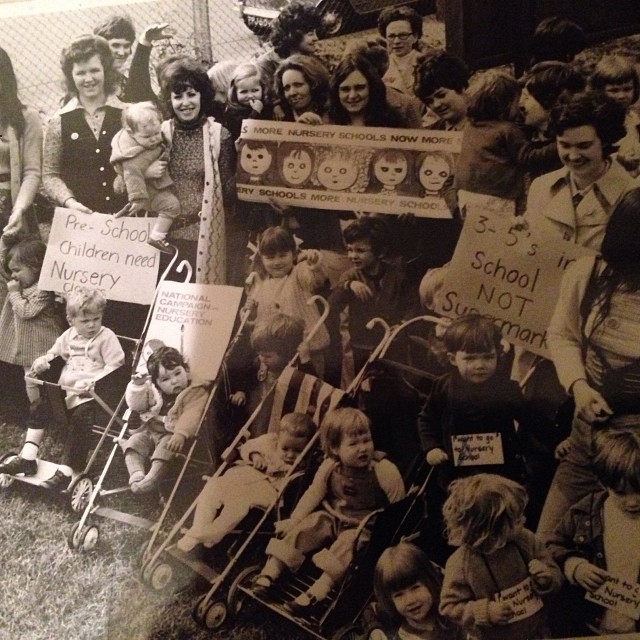
I was brought up with women campaigners marching for free Nursery places (spot me below looking militant already!), against Racism and Nuclear weapons from a very early age which influenced me as a teenager, when I was involved in Anti Poll Tax campaigns and student marches against Thatcherite policies and Apartheid in the 80s.

As a young mum, the friendships I formed were through our children. I went through some of the worst and most challenging experiences of my life. We were all dealing with our own troubles and challenges but, as most of us were single parents, we tried to support each-other and did our best to bring up our children to prove to the world that we were not the scroungers that the media were painting us. All this , whilst learning about ourselves and finding our identity as adult women.

My thirties were focussed on developing my career, which involved getting a degree, setting up a charity and working with hundreds of women from all cultures and backgrounds . These women taught me that the strength of women is universal. Even at our lowest points, we find the resilience to rebuild and reconstruct ourself. Many had escaped from domestic violence, travelled from persecution to safety, overcome huge obstacles but still try to improve themselves and be good parents to their children.

I also had to deal with challenging situations with women, some I believed were my friends, but whose behaviour towards me was resentful, jealous, treacherous and controlling. It was at this point, I discovered that Karpman’s Drama Triangle and I started challenging these ‘friendships’ and started my journey (that has in no way, been a straight road) towards to real friendships I have today.

When I hit my forties, like many other women I shed some of the shackles of the past decades and really felt like I liked myself. As the years have  gone on,  I  have gradually been able to rid myself of some more insecurities and after a long and somewhat difficult recent process , I am heading towards my fifties in a mindful and positive state… mainly due to the many wonderful female friends with whom I have reconnected with recently.

These women travel, are artistic, musical, are sporty and are great mums and strong women. They are business women, writers, carers and creators.  Most of all are simply good people. We laugh, we talk about life (not people), we cry together, and help each other without expectation.

Most of all they accept me as a person, they respect me for who I am – warts and all – they do not take anything from me, emotionally, mentally or financially. Our relationships are not co-dependent but are healthy, honest and kind. These are the real Women to me and the real heroes in my world.

So, what makes some of us women want to bring others down? There are enough people in society making life difficult for us as women.

I can easily reel off stories such as the persecution of MP Dianne Abbott (who received over half of  all abusive tweets directed at women MPs). Period Poverty. Sexual Harassment. Domestic Abuse. The Pay Gap.Government policies that disproportionately impact women. The fact that, in some countries, girls still do not have access to education and in others, women only recently were given the right to vote. The list goes on and on.

Having a woman in the most powerful position in the UK has not helped and has potentially set us back many years in many ways. This is likely to get worse with the potential eradication of Human Rights laws and employment rights.

On personal levels, when a person  has insecurities and are not satisfied with their life, they are likely to project these issues onto others around them.

As  people on the whole,  but for the purpose of this blog, as women, we need to learn to be self-aware and mindful. We have power in our words and actions towards others.

Women are often the main carers of the next generation – as mothers , childcare workers,  primary school teachers – our language and actions when we talk about and to others will form the attitudes of  our children.

Most of all, we need to be aware about how we talk to ourselves. Perhaps if we had been taught at an early age to be kind to ourselves, to accept ourselves and have a voice we may have learnt to be kinder to each other.

This Women’s Day I celebrate all women. I forgive those that have caused me hurt. I apologise to those that I may have upset. I pledge to continue to fight for the rights of women, to support women and encourage women to shine their light. I thank the women who have inspired me and supported me.

Most of all this Women’s Day I find my voice.

I am kind to myself.

I love myself and the skin that I am in.

I am proud of all I have achieved and all I have learnt.

I shine my light.

I hope you do too

Article regarding bullying: https://www.amightygirl.comblog?p=21080

Information about the Karpman Drama Triangle https://www.karpmandramatriangle.com/

Article regarding online abuse: https://newstatesman.com/2017/9/we-tracked-25688-abusive-tweets-sent-women -mps-half-were -directed-diane-abbott

Article regarding Women’s Suffrage: https://matadornetwork.com/read/year-women-became-eligible-vote-country/?fbclid=IwAR0MqqgbzMhnub2qYPBWd-74G3HEVm7CrrKeAJvtCJMCQEnnfOhLkvSnaGc

Welcome to my world

I am writing this blog to share my views, experiences, learning and observations.
I have a learnt many lessons in my 48 years through my own personal journey, my 30 years working in the Youth and Community Sector, being a single parent of two now amazing adults and a daughter of active left-wing parents.
I have been a leader in community organisations, a political campaigner, a change-maker throughout my public life and during this time

Personally, I have been affected by complex trauma which has impacted on my health and well-being. I have recently started to explore the causes of these issues and have been learning how to manage the symptoms. This is a journey of imperfections, a work in progress but an honest attempt to speak my truth about life, social issues and relationships.

I am now finding my true voice and hope that by sharing it I will shine a light for others to find their voices.